Agroupz isn’t a perfect website, but it proves that rankings are earned through consistent effort, not perfection. Despite a DA of just 1, coding challenges, technical limitations, and an imperfect Google Business Profile, the website successfully reached the #1 position on Google for its target keyword and gained visibility on AI platforms such as ChatGPT and Perplexity. This journey taught me that SEO success comes from focusing on what matters, making smart decisions, and continuously improving rather than chasing perfection.
When I started my first SEO project, I had no idea how difficult and rewarding the journey would be.
The project was for Agroupz, a digital marketing agency located in Marthandam, Kanyakumari. My goal was simple:
Rank the website for the keyword “Best Digital Marketing Company in Kanyakumari.”
Looking back today, it sounds straightforward. But at that time, it felt almost impossible.
The website was a basic single-page HTML website with only around 600 words of content. It wasn’t built with advanced frameworks or modern SEO practices. In fact, the website had many issues that would make most SEO professionals uncomfortable.
One of the first things I noticed was the heading structure. Imagine opening a website and finding a double-digit number of H1 tags on a single page. That was the situation. The code wasn’t clean, the structure wasn’t ideal, and there were several technical issues throughout the website.
To make things even harder, the website had a Domain Authority of just 1.
Most people would probably suggest rebuilding the entire website from scratch.
But I decided to work with what I had.
Since I didn’t know coding, I focused on the area I understood best.
content.
I rewrote almost the entire website content. I optimized service descriptions, added relevant keywords, improved calls-to-action, added FAQ sections, optimized images, and made the content more useful for users. My goal wasn’t to stuff keywords everywhere. I wanted Google to clearly understand what the website was about and who it served.
After finishing the content optimization, I submitted the website to Google Search Console and waited.
And waited.
And waited.
More than 20 days passed.
Nothing.
The website was nowhere to be found in Google’s search results.
Every day I searched for my target keyword hoping to see some progress. Every day I left disappointed.
I started questioning myself.
Was the keyword too competitive?
Was a single-page website incapable of ranking?
Did I make mistakes during optimization?
Out of frustration, I revisited the content, made additional improvements, and submitted the pages again through Google Search Console. I kept checking rankings repeatedly, hoping for even the smallest sign of progress.
Then one day, something happened.
I found Agroupz in Google search results.
Not on the first page.
Not on the second page.
Not even close.
It was buried near the last pages of the search results.
Most people would see that as a poor ranking.
I saw it as a victory.
For the first time, Google had recognized the website.
The website existed in search results.
That moment changed everything.
The frustration disappeared, and motivation took over.
I immediately started focusing on off-page SEO and technical improvements. I began building backlinks, creating citations, improving brand mentions, and learning technical SEO concepts that were completely new to me.
I implemented robots.txt, XML sitemaps, schema markup, Markdown document, Cloudflare optimization, structured data, LLMs.txt, and several other improvements. Every day I learned something new and applied it to the website.
Slowly, the rankings started improving.
The website moved from the last pages to the middle pages.
Then it reached the first page.
And eventually, it reached the top position.
What makes this achievement special isn’t just the ranking itself.
It’s the fact that many problems still existed.
The Domain Authority was still only 1.
The code still contained issues.
The text-to-HTML ratio wasn’t perfect.
There were validation errors.
The website structure was still complex.
Even today, sections like #About and #Services are sometimes treated by Google as separate pages, which isn’t ideal from a technical perspective.
I knew these issues existed.
I also knew that touching certain parts of the code without proper knowledge could break the entire website.
As someone who doesn’t come from a development background, I had to make practical decisions.
Some problems needed solving.
Some problems needed managing.
And some problems simply had to be ignored.
Many SEO professionals aim for 100% optimization. That’s a great goal when you have the technical expertise and resources available.
For me, the goal was different.
I wanted results.
I wanted progress.
I wanted rankings.
So instead of chasing perfection, I focused on improvements that could create real impact.
Another interesting part of this journey was Google Business Profile.
To be honest, my GMB wasn’t helping much.
The phone number wasn’t properly verified.
There weren’t enough photos.
The profile lacked many of the trust signals that local SEO experts usually recommend.
There wasn’t even a proper office setup.
Yet despite all these disadvantages, the website continued climbing in rankings.
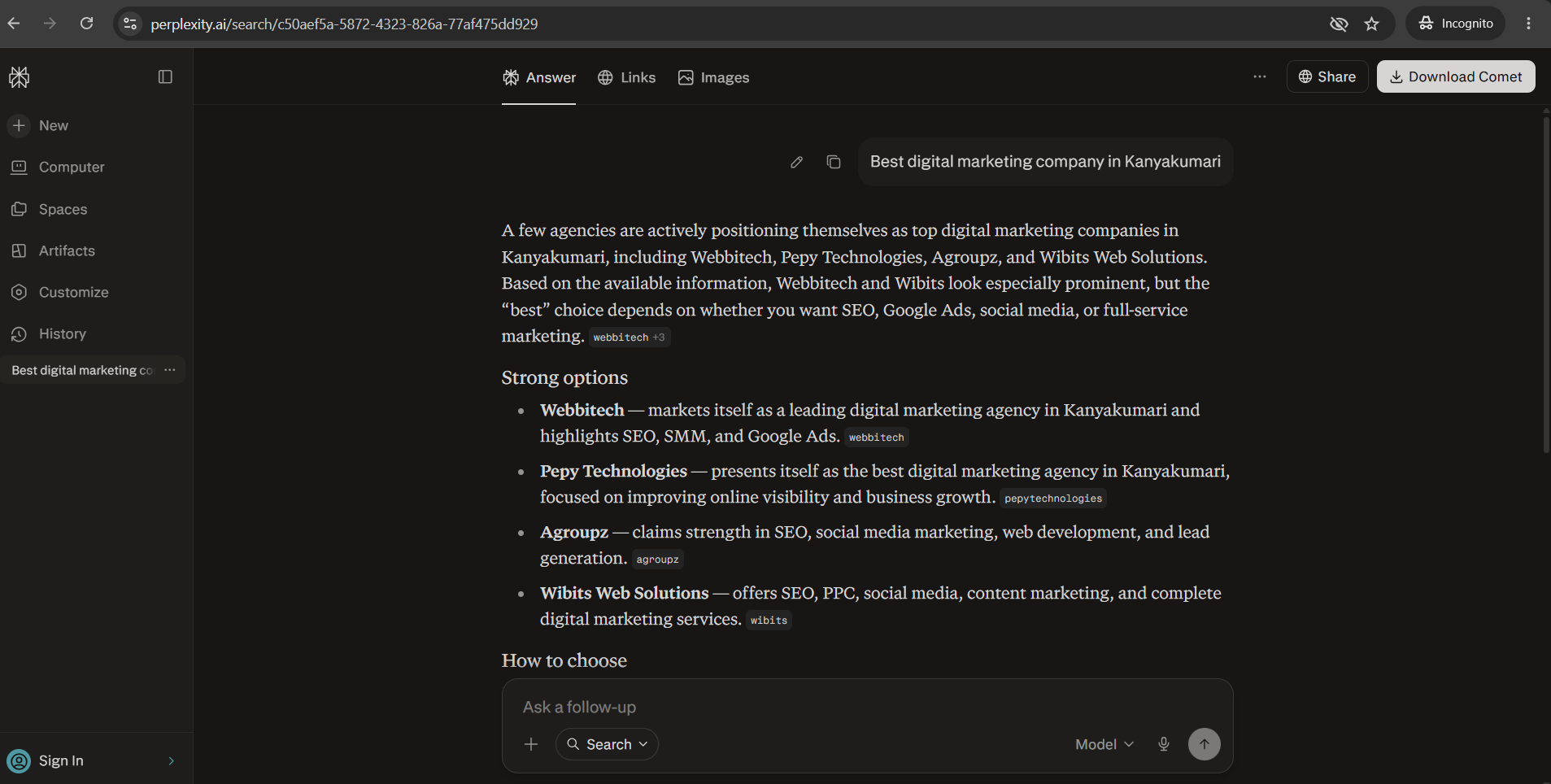
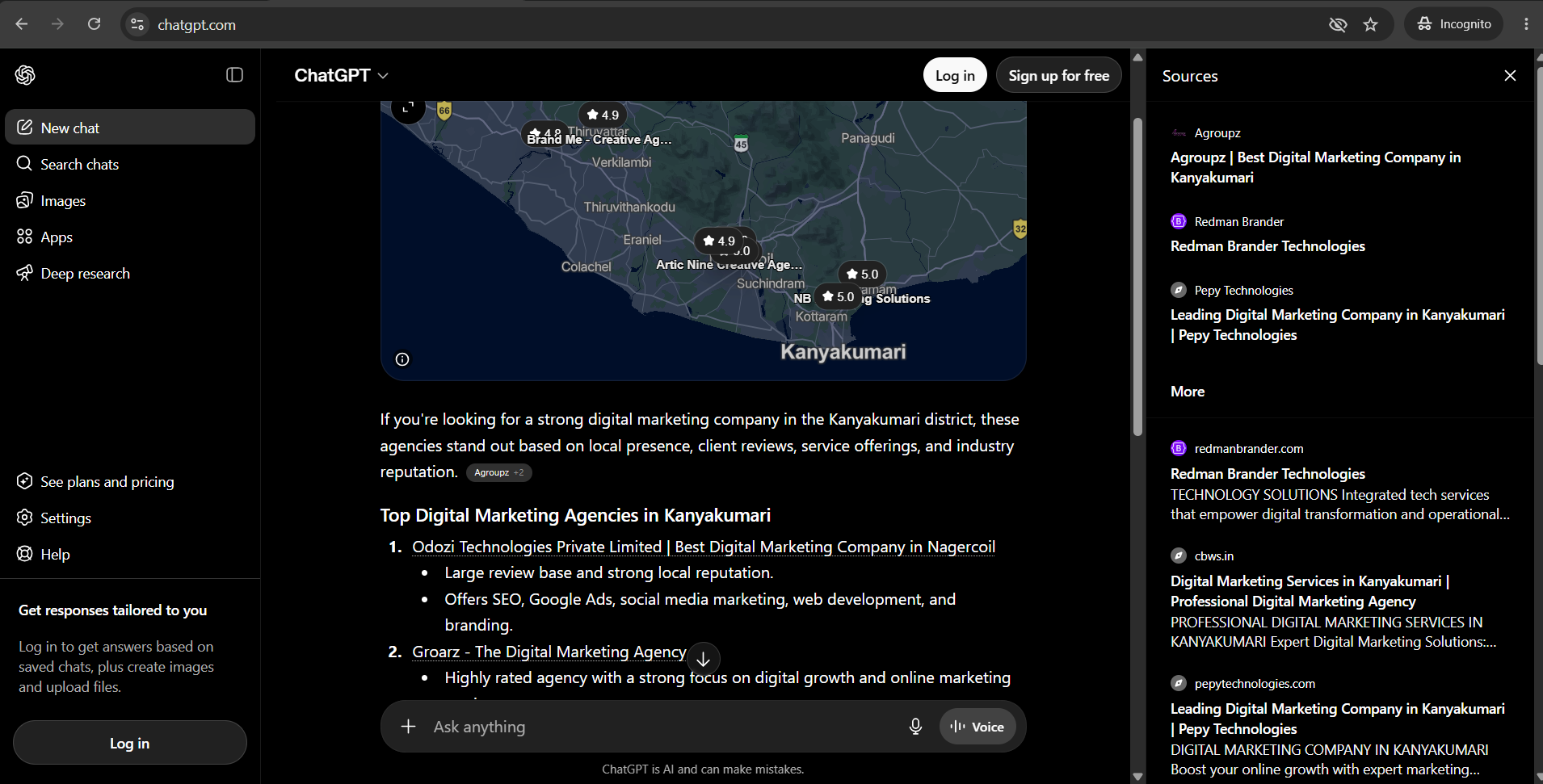
What surprised me even more was seeing Agroupz appear on AI platforms such as ChatGPT and Perplexity, but not in Claude because it takes results only from GMB. Despite being a simple single-page website with low authority and technical limitations, it was gaining visibility beyond traditional search engines.
That was the moment I realized that modern SEO is changing.
It’s no longer just about ranking in Google.
It’s also about building a recognizable entity that search engines and AI platforms can understand.
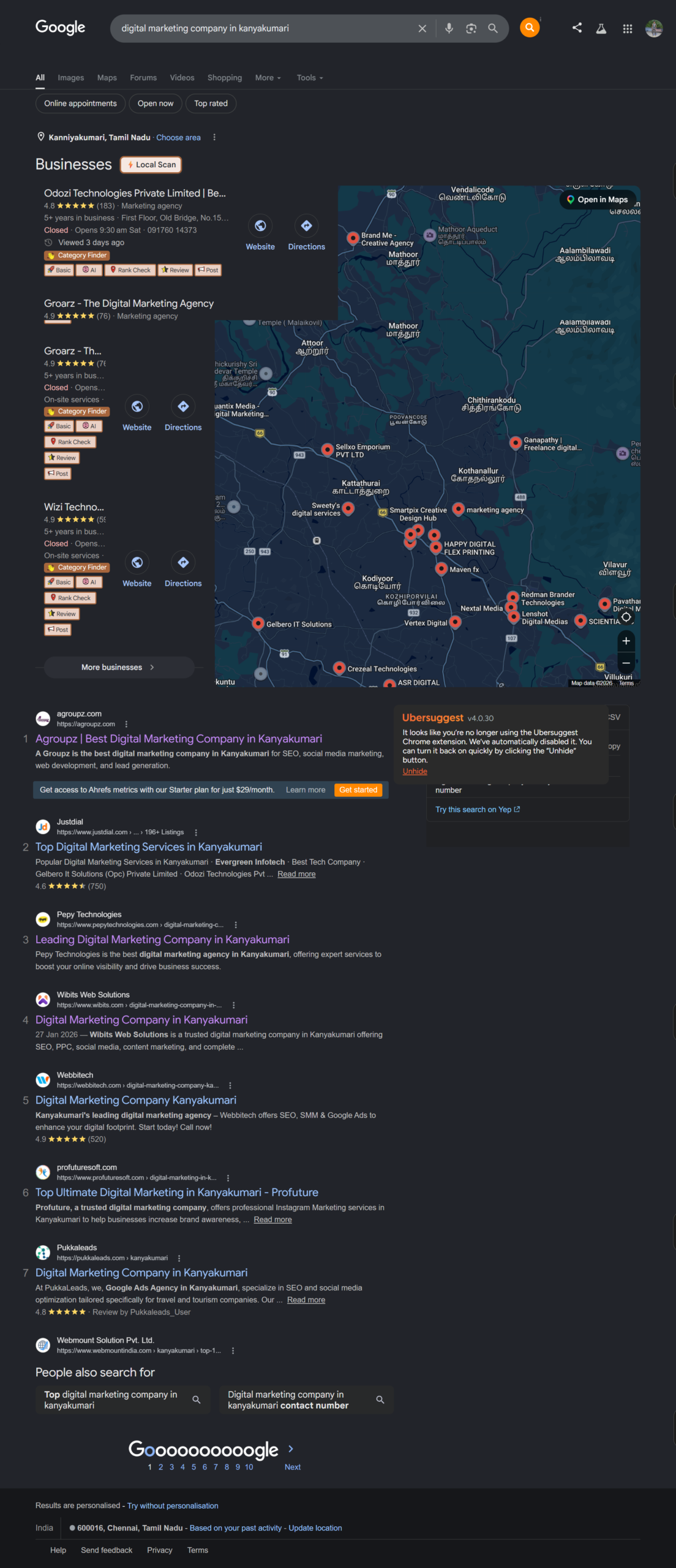
Today, Agroupz ranks in the first position for the keyword “Best Digital Marketing Company in Kanyakumari.”
Whenever I look at that ranking, I don’t just see a keyword position.
I see every late-night optimization.
Every failed attempt.
Every resubmission to Google Search Console.
Every backlink built.
Every technical issue I struggled to understand.
Most importantly, I see proof that perfection is not required to achieve results.
This project taught me that SEO is not about having a perfect website.
It’s about making continuous improvements, solving the problems you can solve, managing the problems you can’t, and staying patient when results take longer than expected.
I am not a developer.
I still don’t know advanced coding.
The website still isn’t perfect.
But it ranks.
And that ranking is a reminder that consistency, learning, and persistence often matter more than perfection.
This was my first SEO project.
And it taught me more than any course ever could.

June 10, 2026